Published
8 minute read

A strong lower face isn’t necessarily about having a dramatically sharp jaw. What often makes a face look balanced is the smooth transition from the cheeks to the jawline and chin. When that transition starts to soften, jowls can become more noticeable and the lower face may begin to look heavier than it once did.
These changes can happen even when the rest of your face still looks youthful. Fortunately, surgery isn’t the only way to address them. A personalized jawline and jowl treatment can use fillers, RF tightening, Quantum RF, biostimulators, or a thoughtful combination of treatments to improve definition while respecting your natural features.
Read on to learn why the lower face changes and how today’s non-surgical options can approach the problem from several angles.
Before choosing a treatment, it helps to understand why the jawline can look different over time. Jowls don’t usually appear because of one isolated change. The face is supported by skin, fat, connective tissue, muscle, and underlying bone. As these structures evolve with age, the lower face can gradually lose the clean definition it once had.
Collagen and elastin production naturally change over time. Skin may become thinner and less resilient. Facial volume can shift, while structural support in certain areas may diminish. Genetics, weight fluctuations, sun exposure, and the natural anatomy of your face can also influence when jowling becomes visible.
Choosing a non-surgical jawline treatment should begin with an assessment rather than a specific product. Two patients can both dislike their jowls but need completely different approaches.
One may primarily need stronger structural support. Another may have adequate facial structure but noticeable skin laxity. A third patient may benefit from treating both concerns. The goal isn’t simply to “fill the jaw.” It’s to identify what is causing the loss of definition and treat that specific concern.
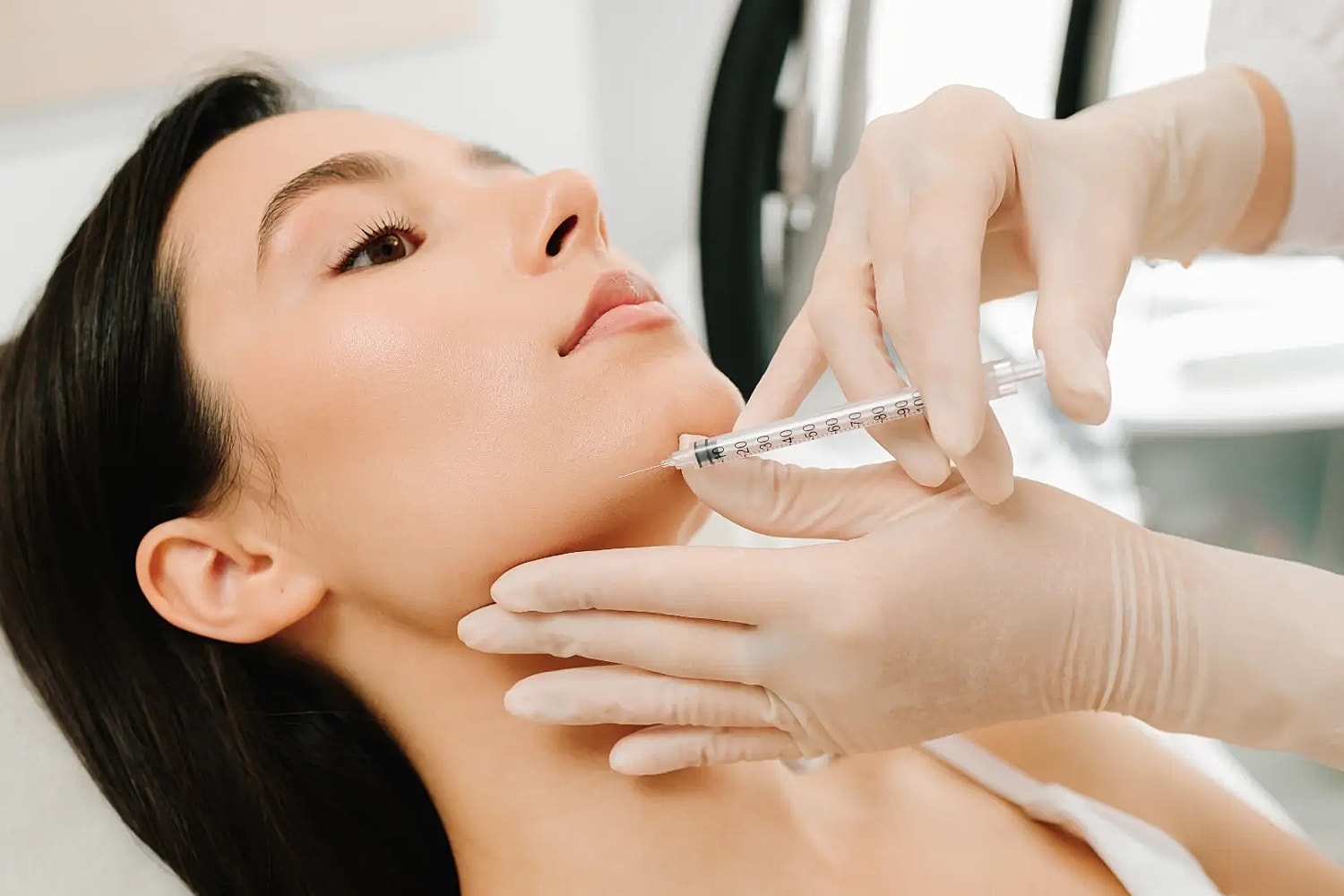
Modern lower-face rejuvenation can address structure, collagen, skin laxity, and contour. At Applied Aesthetic, options include dermal fillers, RF tightening, Quantum RF, and biostimulators such as Sculptra and Radiesse. These treatments can also be combined in a phased approach when appropriate.
Sometimes a jawline looks soft because it lacks enough underlying definition. Dermal fillers can strategically add volume and structure to selected areas of the lower face. Rather than filling the jowls themselves, treatment can focus on creating better proportions around them.
For example, carefully placed filler may help strengthen the appearance of the jawline or improve chin projection. This can create a cleaner transition through the lower face and make mild jowling appear less dominant.
The key word is strategic. Adding too much volume to an already heavy lower face can work against the desired result. A thoughtful treatment plan considers facial proportions from multiple angles. The objective is not to make the jaw dramatically larger. It is to restore or enhance the structural definition that supports a balanced profile.
Dermal filler can be particularly appealing when patients want visible contour improvement without waiting months for collagen remodeling.
Not every soft jawline needs more volume. If laxity is the primary concern, adding filler alone may not address what you’re seeing. This is where radiofrequency treatments can play an important role.
RF tightening uses controlled radiofrequency energy to heat targeted tissue. This thermal stimulation supports collagen remodeling, which can gradually improve the appearance of firmness and skin quality. For patients with mild to moderate laxity, RF can complement the natural architecture of the face rather than changing its shape with added volume.
Results generally develop progressively because collagen remodeling takes time. That gradual improvement can be particularly appealing to patients who want their face to look refreshed without an obvious overnight transformation.
RF treatments may also make sense for someone who likes their underlying facial proportions but feels that loose skin is blurring the jawline.
Some patients need more than surface-level tightening. Quantum RF, including Ignite QuantumRF 10, provides another option for addressing lower-face laxity. It uses radiofrequency energy with the goal of creating more meaningful tightening and contouring within targeted tissues. This approach can be valuable when early jowling has progressed beyond very mild skin looseness.
By working at a deeper level, Quantum RF can target the structural component of laxity rather than relying exclusively on surface improvement. For the right patient, this can create a more defined transition between the face and neck while improving the appearance of jowls.
It is still important to keep expectations realistic. Non-surgical technology cannot reproduce every result achievable with a surgical facelift. The advantage is different. Patients can pursue meaningful improvement without choosing traditional facial surgery.
A consultation can determine whether conventional RF tightening or a treatment such as Quantum RF better matches the degree of laxity present.
Sometimes what the face needs isn’t simply more filler. It needs better support over time. Sculptra is a biostimulator that encourages the body to produce additional collagen. Instead of functioning solely as an instant volumizing product, it works gradually as the skin’s underlying support improves. This can be especially useful when age-related collagen loss contributes to broader changes in facial structure and skin quality.
The results develop differently from traditional filler. You shouldn’t expect to leave treatment with the complete final effect. Collagen rebuilding occurs progressively, creating changes over the following weeks and months.
For lower-face rejuvenation, that gradual process can be valuable. Rather than simply adding noticeable volume along the jaw, Sculptra can become part of a larger strategy for improving facial support. Patients who prioritize subtle, progressive rejuvenation may find this approach especially appealing.
Radiesse is another biostimulator used within lower-face rejuvenation strategies. Its properties allow it to provide structural support while also encouraging collagen production. Depending on how it is used and the patient’s anatomy, this can make it a useful option for improving contour and supporting areas where definition has diminished.
That combination gives Radiesse an interesting role between immediate contouring and longer-term regenerative improvement. For a jawline that needs more visible structural reinforcement, it may be considered as part of a customized plan. The exact treatment areas and technique matter greatly because lower-face anatomy varies significantly from person to person.
Sculptra and Radiesse are both biostimulators, but they aren’t interchangeable in every situation. Choosing between them should come down to anatomy, tissue quality, treatment goals, and the type of improvement being pursued.
The most noticeable lower-face changes often involve more than one issue. Imagine a patient with mild loss of jaw structure, declining collagen, and loose skin around the jowls. Filling the jaw may improve definition, but it won’t directly tighten all of the lax skin.
RF may improve firmness, but it cannot necessarily replace lost structural support. This is where combination treatment becomes especially valuable. Applied Aesthetic’s approach may combine structural filler, biostimulators, and RF tightening in a phased protocol. Rather than performing every treatment at once, the sequence can be mapped according to the patient’s anatomy.
For example, one phase might focus on rebuilding structural support. Another may address collagen and tissue quality. RF tightening can then complement those improvements by targeting laxity.
The exact order will vary. This layered approach is one of the reasons jawline and jowl treatment in Long Island has moved well beyond simply injecting filler into the lower face. Modern facial rejuvenation looks at how different tissues work together.

The chin may not be the first thing you notice when looking at your jowls, but its proportions can influence how the entire jawline appears. A chin with limited projection can make the lower face look less defined from the side. It may also affect how smoothly the jawline transitions toward the center of the face.
For some patients, carefully improving chin structure can create a stronger foundation for the overall lower-face contour. This doesn’t mean everyone with jowls needs chin filler. It means the jawline should be evaluated as part of a connected facial structure.
Good facial balancing isn’t about chasing individual imperfections. It is about understanding how neighboring features influence one another.
A changing jawline doesn’t mean your face needs to become dramatically different. Often, the most elegant treatment simply restores some of the definition that time has softened.
A personalized jawline and jowl treatment can draw from dermal fillers, RF tightening, Quantum RF, Sculptra, Radiesse, or a carefully phased combination. The focus is on your anatomy and the specific reason your lower face has changed.
At Applied Aesthetic in Garden City, NY, Natalie Sharp, FNP-BC, brings more than a decade of dermatology experience to every treatment plan. As an ANCC Board-Certified Family Nurse Practitioner, she has built her reputation on delivering natural-looking outcomes through thoughtful evaluation and personalized care.
Schedule your appointment today!