
Private Aesthetic Training & Clinical Mentorship
Advanced, hands-on education for licensed medical professionals
Learn to assess more intelligently, treat more intentionally, and create refined, natural-looking results through private aesthetic training with Natalie Sharp, FNP-BC.
Applied Aesthetic’s training experiences are designed for medical professionals seeking more than a basic injection course. Each training combines facial assessment, anatomy, treatment planning, product selection, technical instruction, complication awareness, and supervised hands-on practice in an intimate clinical setting.
Rather than teaching isolated injection points or standardized formulas, Natalie teaches practitioners to assess the face as a whole and make thoughtful decisions based on anatomy, tissue quality, movement, structural support, skin health, and each patient’s long-term goals.
Learn How to Think Like an Advanced Aesthetic Provider
Aesthetic medicine is not simply about learning where to place a needle.
Successful treatment begins with understanding the patient—their anatomy, proportions, skin quality, facial movement, aging patterns, medical history, expectations, and tolerance for change.
At Applied Aesthetic, education is centered on clinical judgment, not formulas. Trainees learn to assess each patient individually, establish appropriate treatment priorities, and create results that preserve identity while improving balance, structure, and skin quality.
The goal is not to teach practitioners to perform more treatments.
It is to teach them to make better decisions.
The Applied Aesthetic Approach
Natalie’s philosophy is grounded in conservative treatment, whole-face assessment, and long-term patient planning.
Rather than addressing concerns in isolation, trainees learn to understand how skin quality, collagen loss, skeletal structure, tissue descent, facial movement, and volume changes work together.
Treatment is then approached in a logical sequence:
Skin Quality
Evaluate pigmentation, texture, elasticity, vascularity, hydration, and overall skin health.
Trainees learn when the patient may benefit more from laser, resurfacing, microneedling, regenerative treatments, or medical-grade skincare before additional volume is considered.
Structural Support
Identify where age-related changes have affected support, contour, tissue quality, and facial balance.
This may include collagen-stimulating treatments, strategic structural filler, regenerative procedures, or a combination approach.
Refinement
Use targeted dermal filler and neuromodulators to improve balance, movement, and proportion without overcorrecting or changing the patient’s identity.
This three-step framework allows practitioners to move beyond treating individual lines and begin developing cohesive, long-term treatment plans.
Private Training Options
One-on-One Hands-On Training
A private training day customized to your current experience, clinical interests, and professional goals.
One-on-one training allows for direct instruction, focused feedback, and meaningful hands-on experience without the limitations of a large-group course.
Each training day includes a combination of clinical education, facial assessment, treatment planning, instructor demonstration, and supervised treatment of selected models.
Training may include:
- Comprehensive facial assessment
- Relevant facial anatomy
- Patient selection
- Contraindications and risk factors
- Product selection
- Treatment planning
- Treatment sequencing
- Needle and cannula technique
- Injection depth and tissue planes
- Dosing and placement
- Consultation strategy
- Consent and documentation
- Before-and-after photography
- Managing patient expectations
- Recognizing potential complications
- Emergency preparedness
- Post-treatment care
- Long-term treatment-plan development
Suggested format
Training hours
10:00 AM–5:00 PM
Class size
Models
Format
Certificate
Investment
Clinical Shadow Day
A private observation experience for medical professionals who want to see how a boutique aesthetic practice approaches consultations, treatment planning, patient communication, and clinical care.
A shadow day provides insight into the daily workflow at Applied Aesthetic and allows participants to observe how clinical decisions are made in real time.
Depending on the scheduled patients, the day may include observation of:
- New-patient consultations
- Facial assessment
- Treatment planning
- Neuromodulator treatments
- Dermal filler treatments
- Biostimulator treatments
- Regenerative procedures
- Skin-quality treatments
- Combination treatment planning
- Before-and-after photography
- Patient education
- Consent and documentation
- Follow-up appointments
- Practice workflow
- Patient experience
- Product recommendations
Because every clinical day is different, specific procedures cannot be guaranteed.
Shadowing is observational unless otherwise arranged and legally permitted.
Areas of Training
Private training may be customized around one of the following areas.
Final content is based on the trainee’s experience, professional license, treatment goals, and model availability.
Neuromodulator Training
Develop a more thoughtful understanding of facial movement, dosing,
placement, symmetry, and patient-specific treatment planning.
Training may include the use of Botox Cosmetic, Xeomin, Dysport, Daxxify,
or Jeuveau, depending on the selected topic and clinical circumstances.
Areas may include:
- Frontalis
- Glabella
- Crow’s feet
- Brow positioning
- Bunny lines
- Nasalis
- Lip flip
- Gummy smile
- Depressor anguli oris
- Mentalis
- Masseters
- Platysmal bands
- Neck refinement
- Lower-face neuromodulator treatment
- Male neuromodulator considerations
- Asymmetry assessment
- Conservative dosing
- Avoiding brow heaviness and unwanted feminization
- Follow-up assessment and adjustment
The emphasis is on preserving expression, respecting anatomy, and achieving balanced results rather than following a standardized injection map.
Dermal Filler and Facial Balancing
strategy rather than as an isolated treatment.
Training focuses on facial proportions, structural support, tissue
characteristics, product selection, treatment priorities, and conservative
correction.
Potential treatment areas include:
- Lips
- Chin
- Cheeks
- Midface
- Jawline
- Temples
- Perioral region
- Nasolabial folds
- Marionette region
- Lower-face balancing
- Full-face assessment
Training may cover:
- Facial analysis
- Product rheology and selection
- Needle versus cannula
- Appropriate treatment planes
- Structural versus superficial placement
- Aspiration considerations
- Vascular anatomy
- Risk reduction
- Treatment sequencing
- Managing asymmetry
- Recognizing previous filler
- Identifying migrated or poorly placed filler
- Knowing when not to inject
- Dissolving considerations
- Creating staged treatment plans
Advanced and higher-risk treatment areas are offered only when appropriate for the trainee’s experience level and legal scope of practice.
Lip Filler Training
A focused training experience centered on lip assessment, anatomy, technique selection, symmetry, proportion, and natural-looking enhancement.
The goal is not to teach one signature pattern that is applied to every patient. Trainees learn to recognize differences in lip anatomy and select an approach based on the patient’s structure, tissue, movement, history, and desired outcome.
Training may include:
- Lip anatomy
- Patient selection
- Consultation and expectation setting
- Lip proportions
- Dental and skeletal considerations
- Border definition
- Hydration
- Shape refinement
- Vertical height
- Projection
- Upper-to-lower lip balance
- Correction of asymmetry
- Classic techniques
- Vertical injection techniques
- Needle and cannula considerations
- Product selection
- Swelling and bruising counseling
- Avoiding migration and overfilling
- Staged treatment planning
- Vascular compromise recognition
Biostimulator Training
Learn how to incorporate collagen-stimulating treatments into a
comprehensive facial-rejuvenation plan.
Biostimulator training is ideal for providers who want to move beyond
volume replacement and better understand how to improve structural support,
tissue quality, and collagen production over time.
Training may include:
- Sculptra
- Radiesse
- Hyperdilute Radiesse
- Patient selection
- Contraindications
- Product preparation
- Reconstitution and dilution
- Treatment planes
- Facial anatomy
- Facial applications
- Neck applications
- Décolleté applications
- Hand rejuvenation
- Collagen-building treatment plans
- Treatment intervals
- Product selection
- Combining biostimulators with HA filler
- Combining biostimulators with energy-based treatments
- Setting realistic expectations
- Post-treatment care
- Nodule-risk reduction
- Managing delayed concerns
Trainees learn when to restore structure, when to improve tissue quality, and when traditional filler may not be the most appropriate first step.
Sculptra Training
A focused course covering patient selection, facial assessment,
reconstitution, injection planning, treatment intervals, and long-term
collagen-building strategies.
Training may cover:
- Appropriate patient selection
- Contraindications
- Reconstitution
- Product preparation
- Facial anatomy
- Safe treatment areas
- Injection depth
- Cannula and needle considerations
- Distribution patterns
- Facial balancing
- Treatment planning by decade
- Number of vials
- Number of sessions
- Patient counseling
- Massage instructions
- Avoiding inappropriate placement
- Nodule-risk reduction
- Integration with filler, neuromodulators, and devices
Radiesse and Hyperdilute Radiesse Training
Learn how calcium hydroxylapatite may be used for structural support,
contour refinement, and biostimulation.
Training may include:
- Radiesse product characteristics
- Patient selection
- Structural Radiesse
- Hyperdilute Radiesse
- Dilution options
- Facial treatment
- Jawline treatment
- Lower-face support
- Neck treatment
- Décolleté treatment
- Hand rejuvenation
- Cannula technique
- Appropriate depth
- Treatment planning
- Combination treatment
- Risk reduction
- Post-treatment care
PRF and Regenerative Aesthetics
Learn how platelet-rich fibrin and regenerative treatments may be
incorporated into aesthetic treatment plans for patients seeking subtle, biologically driven improvement.
Training may include:
- PRF preparation
- PRF EZ Gel
- Blood collection considerations
- Centrifugation principles
- Product handling
- Under-eye assessment
- Tear-trough anatomy
- Patient selection
- Skin-quality applications
- Treatment technique
- Treatment-series planning
- Combination protocols
- Setting realistic expectations
- Photography and progress tracking
- Post-treatment instructions
Particular attention is given to selecting patients who are appropriate for regenerative treatment and identifying those who may require a different approach.
Full-Face Assessment and Treatment Planning
One of the most important skills in aesthetic medicine is learning to identify the correct treatment priority.
This training is designed to strengthen clinical judgment, consultation skills, and the ability to build individualized treatment plans.
Training may include:
- Facial proportions
- Facial shape
- Skeletal support
- Fat-compartment changes
- Tissue descent
- Skin quality
- Facial movement
- Asymmetry
- Profile assessment
- Frontal assessment
- Oblique assessment
- Aging patterns
- Patient priorities
- Treatment sequencing
- Budget-based planning
- Staged correction
- Avoiding unnecessary treatment
- Presenting recommendations without pressure
- Creating annual treatment plans
- Documenting clinical rationale
Trainees learn how to distinguish between what a patient requests and what may produce the most balanced and appropriate result.
What Makes Applied Aesthetic Training Different
Assessment Before Injection
Technique is important, but assessment determines whether a treatment should be performed at all.
Trainees learn how to recognize the underlying cause of a concern, determine the appropriate treatment priority, and avoid treating every complaint with filler or neuromodulator.
Whole-Face Thinking
The face is not treated as a collection of unrelated areas.
Each patient is evaluated through the relationship between skin, structure, volume, movement, proportion, and aging.
Skin-First Philosophy
In some patients, improving pigmentation, texture, collagen, or tissue quality produces a better outcome than adding volume.
Trainees learn how to identify when skin treatment should come first.
Natural, Measured Results
The objective is refinement, not transformation.
Training emphasizes restraint, balance, preservation of identity, and staged treatment when appropriate.
Private Instruction
Applied Aesthetic training is intentionally intimate.
Smaller training formats allow for direct feedback, individualized discussion, and a more meaningful learning experience.
Real-World Clinical Education
Training extends beyond technical placement.
Participants may also learn about consultation structure, patient communication, photography, documentation, follow-up, complication preparedness, treatment-plan presentation, and patient retention.
Customized Curriculum
There is no one-size-fits-all training day.
The curriculum is developed based on the trainee’s current experience, comfort level, preferred treatment category, and clinical goals.
Meet Your Educator
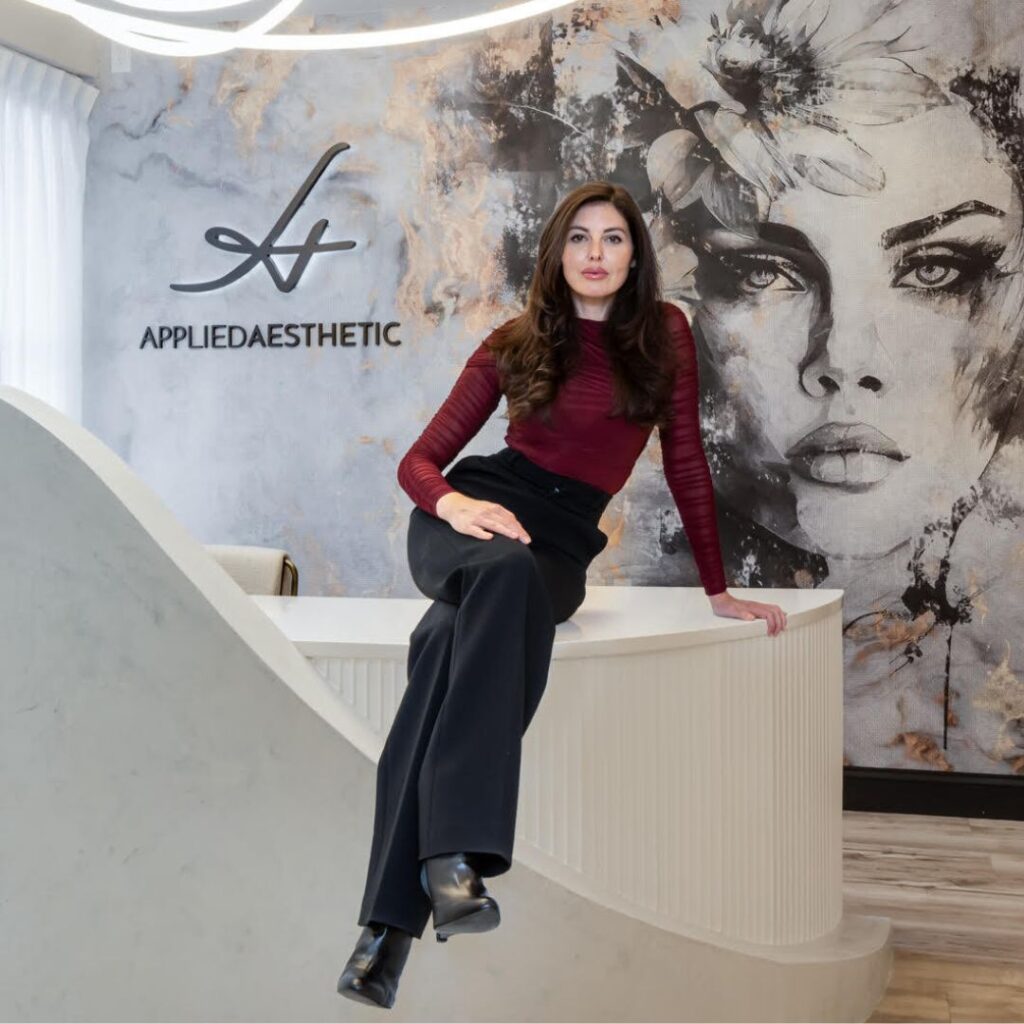
NATALIE SHARP, FNP-BC
Founder and Clinical Director of Applied Aesthetic
Natalie Sharp is a board-certified family nurse practitioner with more than
a decade of experience in cosmetic and medical dermatology.
Her approach to aesthetic medicine is rooted in facial assessment, skin
health, structural support, conservative treatment, and long-term planning.
As the founder of Applied Aesthetic in Garden City, New York, Natalie has
developed a boutique practice centered on refined outcomes and highly
individualized care.
Her clinical experience includes neuromodulators, dermal fillers, collagen
biostimulators, regenerative treatments, energy-based devices, skin
resurfacing, facial balancing, and combination treatment planning.
Natalie’s teaching style is direct, practical, and clinically focused. She
helps trainees understand not only how a treatment is performed, but why it
may—or may not—be appropriate for a particular patient.
Her goal is to help medical professionals develop the clinical judgment,
technical confidence, and aesthetic restraint required to build a
sustainable career in aesthetic medicine.
Who May Participate
Applied Aesthetic training is intended for appropriately licensed medical
professionals who are legally permitted to perform the procedures included
in their selected course.
Participants may include:
– Physicians
– Nurse practitioners
– Physician assistants
– Registered nurses
– Dentists, where legally permitted
– Other appropriately licensed medical professionals
Eligibility is reviewed before enrollment.
Some courses may be appropriate for newer providers, while advanced
training may require prior injection experience.
Enrollment in an Applied Aesthetic course does not independently authorize
any participant to perform medical procedures.
Each trainee is responsible for confirming that their professional license,
scope of practice, supervisory or collaborative requirements, malpractice
coverage, employer policies, and state regulations permit participation and
subsequent clinical practice.
Applied Aesthetic reserves the right to decline or modify training
participation when a requested procedure is not appropriate for the
trainee’s experience or legal scope.
The Training Experience
Before Your Training
Each participant completes a professional intake form.
The intake allows us to review your:
– Professional license
– State of licensure
– Current role
– Clinical background
– Aesthetic experience
– Previous training
– Current confidence level
– Preferred training topic
– Specific areas of difficulty
– Professional goals
– Desired learning outcomes
You may also be asked to provide proof of active licensure and professional liability coverage.
Once your application is reviewed, our team will recommend the most appropriate training format and focus.
During Your Training
A private training day may include:
Clinical Foundation
Review anatomy, assessment, product characteristics, indications, contraindications, technique, safety, and treatment planning.
Patient Assessment
Evaluate live models and discuss clinical findings, treatment priorities, potential limitations, and expected outcomes.
Treatment Planning
Develop a thoughtful plan based on the patient’s anatomy, goals, medical history, tissue quality, and budget.
Instructor Demonstration
Observe Natalie perform selected portions of the treatment while discussing decision-making, placement, depth, dosage, and technique.
Supervised Hands-On Practice
Perform approved treatment steps under direct supervision when legally and clinically appropriate.
Photography and Documentation
Review standardized photography, informed consent, charting, and treatment documentation.
Case Review
Discuss the treatment outcome, post-care, potential follow-up needs, and alternative approaches.
After Your Training
Depending on the course selected, participants may receive:
– Certificate of completion
– Course workbook
– Treatment-planning guide
– Anatomy references
– Suggested supply list
– Photography guide
– Consultation framework
– Documentation considerations
– Post-care templates
– Recommended reading
– Limited post-training support
Any post-training support period, method, and limitations will be stated in the training agreement.
Models
Models may be coordinated by Applied Aesthetic, the trainee, or both.
All models must complete appropriate screening, medical history,
photography, consent, and treatment documentation.
Final treatment decisions are made by Natalie Sharp, FNP-BC, based on
clinical appropriateness and safety.
A scheduled model may be declined, or the proposed treatment may be
modified, if the patient is not an appropriate candidate.
Specific treatment areas and procedures cannot be guaranteed.
Depending on the training arrangement, models may be responsible for a
reduced product or treatment fee. All applicable costs will be discussed
before the training date.
Training Investment
Training Policies
Retainer
Remaining Balance
Rescheduling
Cancellations
Model Changes
Attendance
Photography and Confidentiality
Questions? We have answers!
Do I need previous aesthetic experience?
Not necessarily.
Some training may be appropriate for newer medical professionals, while advanced treatment categories require prior education and clinical experience.
Your background will be reviewed before enrollment so the curriculum can be matched to your level.
Will I be able to inject during the course?
Are models provided?
How many models are included?
Can I learn several procedures in one day?
Which products will be used?
Is product included in the course fee?
Product inclusion varies by course.
Your proposal will clearly state whether product, supplies, and model-treatment costs are included.
Do you offer training for beginners?
Do you offer advanced training?
Do I receive continuing-education credit?
Can I bring my own model?
Can I bring a colleague or employee?
Is shadowing hands-on?
Can training take place at my office?
Is post-training support included?
Apply for Private Training
Elevate the Way You Assess, Plan, and Treat
Private. Practical. Clinically Focused.
Build the assessment skills, treatment judgment, and technical confidence required to deliver thoughtful, natural-looking aesthetic results.